
How to Progress Your Home Training Without Buying More Equipment
Use better structure, tempo and consistency before deciding that you need another piece of kit.
Published: 2026-09-09
When a workout starts to feel familiar, it is tempting to assume that the answer is more equipment. Sometimes it is. More often, the next useful step is to make the current work clearer: better range of motion, steadier tempo, more reliable sessions or a small increase in total work.
Use a baseline week
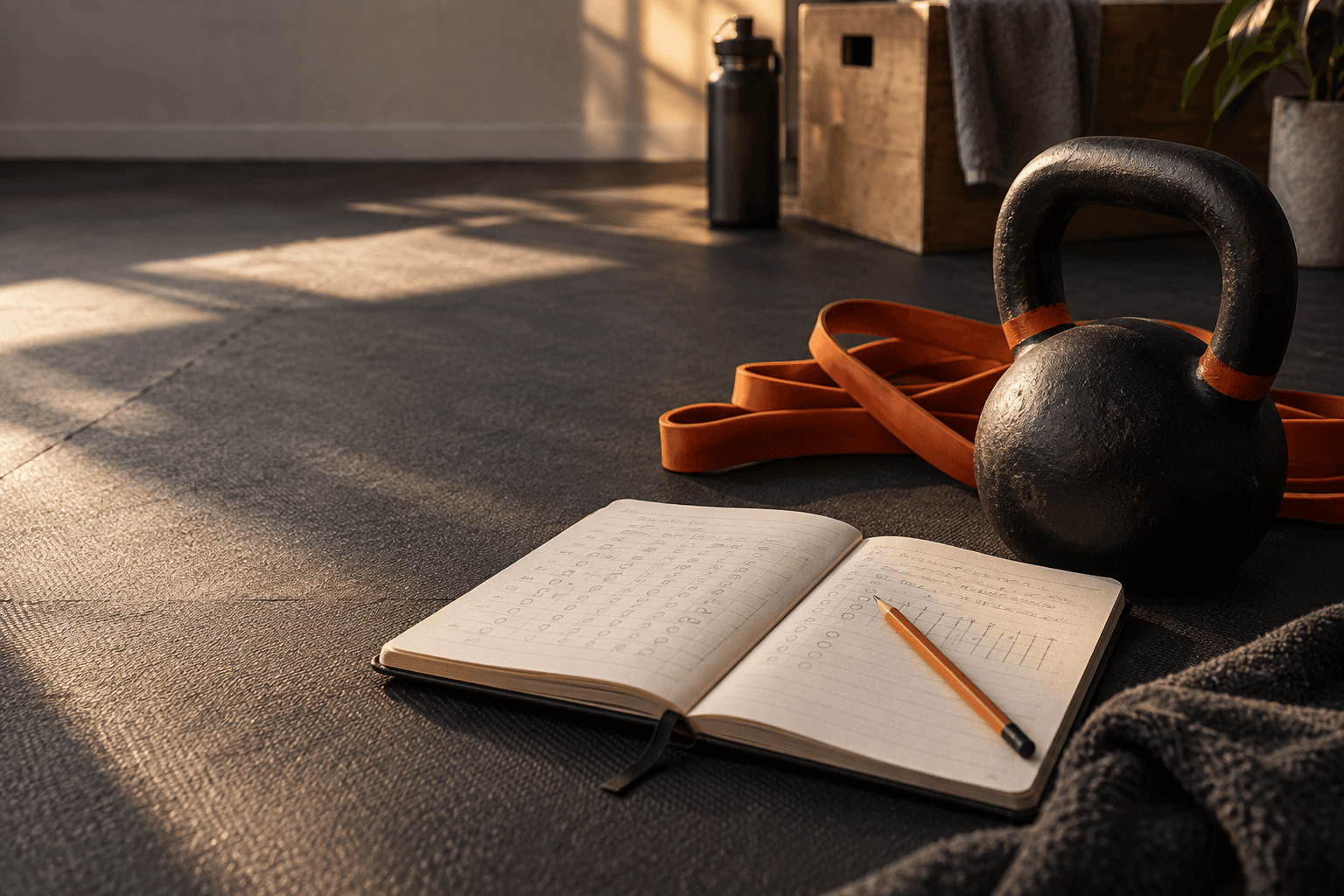
For one week, repeat two or three sessions and write down what you actually completed. Record the exercise, load or band, sets, repetitions and perceived effort. A baseline is useful because it tells you whether a change is real. Without it, every session becomes a new experiment.
Four ways to progress
- Add repetitions while keeping the same control and range.
- Add one set to a movement that you recover from well.
- Slow the lowering phase to three seconds, then pause briefly in the strongest position.
- Reduce rest slightly only when technique remains consistent.
Choose one method for one or two weeks. Combining every method at once turns a manageable plan into a hard-to-repeat session.
Make conditioning measurable
Repeat a short, sensible circuit once every two weeks: for example, five rounds of squats, rows, press-ups and a brisk walk. Track the total time only if you can keep the movement standard the same. Faster with worse positions is not useful progress.
Know when more equipment is justified
An upgrade is sensible when it solves a specific, repeated problem. Your heaviest dumbbell may no longer challenge your squat or hinge. Your band may be too light for rows but too heavy for presses. You may need a second load to keep sessions moving without long adjustments. Name the constraint first, then buy to solve it.
Progress is deliberately unglamorous: show up, record the work, make one small change and reassess. That approach builds a training habit that can grow with you.